
Reviewed by: John Baur, PT, DPT, OCS, FAAOMPT
Hall and colleagues present an updated clinical practice guideline for vestibular physical therapy (VPT) in people with peripheral vestibular hypofunction. The guideline revises the 2016 version from the Academy of Neurologic Physical Therapy of the American Physical Therapy Association and focuses on exercise-based care for acute, subacute, and chronic unilateral vestibular hypofunction (UVH) and bilateral vestibular hypofunction (BVH). Its clinical importance is substantial: uncompensated vestibular loss can cause dizziness, disequilibrium, oscillopsia, impaired gaze stability, gait instability, falls, reduced participation, difficulty driving or working, and lower quality of life. The authors emphasize that vestibular dysfunction is common, increases with age, and carries a meaningful individual and economic burden. As a result, the guideline is designed not merely to summarize evidence, but to translate that evidence into practical action statements for clinicians treating patients with confirmed peripheral vestibular deficits.
The methods are rigorous and transparent. The guideline development group performed a systematic literature review of studies published from 2015 through June 2020, searching multiple databases and adding evidence to the prior guideline base. Eligible evidence included meta-analyses, systematic reviews, randomized controlled trials, cohort studies, case-control studies, and case series in human participants. Sixty-seven articles were identified as relevant and appraised for level of evidence. Randomized trials were evaluated with the APTA Critical Appraisal Tool for Experimental Interventions, and cohort studies were assessed with Scottish Intercollegiate Guidelines Network methodology. Recommendations were graded according to evidence quality and the balance of benefits, risks, burden, feasibility, and patient values. The guideline is intentionally limited to peripheral vestibular hypofunction confirmed by objective vestibular testing; it does not directly address central vestibular disorders, primary benign paroxysmal positional vertigo, concussion, migraine, or patients with dizziness symptoms but no documented vestibular hypofunction.
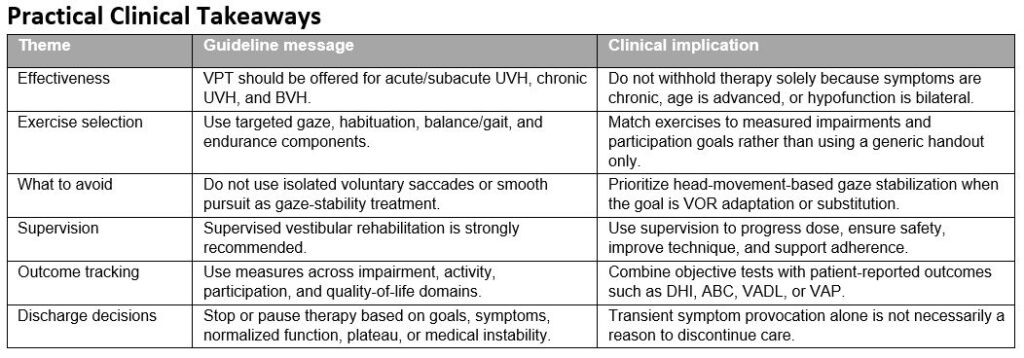
The central message is clear: VPT provides a substantial benefit for adults with peripheral vestibular hypofunction and should be offered to patients with related impairments, activity limitations, and participation restrictions. Strong recommendations support VPT for acute/subacute UVH, chronic UVH, and BVH. Expected benefits include reduced dizziness and motion-provoked symptoms, improved gaze and postural stability, better gait and functional mobility, reduced fall risk, improved activities of daily living, and improved quality of life. The guideline also highlights newer evidence suggesting that initiating VPT early after acute UVH, when medically safe, may improve recovery and shorten the episode of care. Although BVH patients can improve, the authors note that some outcomes, especially dynamic postural stability and quality of life, may not improve to the same degree as in UVH.
The recommended intervention framework is active, individualized, and impairment driven. Contemporary VPT generally includes four components: gaze stabilization exercises, habituation or visual-motion exposure exercises, balance and gait training, and walking or general endurance activities. Gaze stabilization exercises are designed to promote vestibulo-ocular reflex adaptation or substitution through head movement while maintaining visual focus. Habituation exercises expose the patient to provocative movements or visual environments in a graded way so that symptoms decrease over time. Balance and gait training challenge sensory integration, postural control, head movement during stance and gait, walking on varied surfaces, dual-tasking, and fall-risk demands. General conditioning may be useful as part of a broader program, but the guideline notes that conditioning alone, without a gaze or balance component, is not sufficient for vestibular hypofunction.
Several recommendations refine what clinicians should avoid or use selectively. The guideline strongly recommends against prescribing voluntary saccadic or smooth-pursuit eye movements in isolation as gaze-stability exercises for peripheral vestibular hypofunction. This distinction matters clinically because isolated eye movements do not provide the head-movement error signal needed for vestibulo-ocular reflex adaptation. In contrast, targeted modalities such as low-technology balance training, optokinetic stimulation, virtual reality, platform perturbations, or vibrotactile feedback may be considered when they match the patient’s specific limitations, preferences, and available resources. These modalities should not replace individualized clinical reasoning; rather, they may help address visual dependence, motion sensitivity, sensory reweighting, or adherence barriers in selected patients.
Dosage guidance is one of the most practical contributions of the guideline, although the evidence for precise dosing is weaker than the evidence for overall VPT effectiveness. For gaze stabilization, clinicians may prescribe weekly clinic visits plus a home program totaling at least 12 minutes per day, performed three times daily, for acute/subacute UVH. For chronic UVH, the recommended minimum is 20 minutes per day, performed three to five times daily for four to six weeks. For BVH, the guideline suggests 20 to 40 minutes per day, three to five times daily, for approximately five to seven weeks. For balance training, clinicians may prescribe at least 20 minutes daily for four to six weeks in chronic UVH. Specific balance-dose recommendations cannot be made for acute/subacute UVH, and for BVH the guideline supports six to nine weeks of balance exercise based largely on expert opinion. These dose recommendations should be documented and adjusted according to symptom irritability, fall risk, objective progress, and patient adherence.
Supervision is another major emphasis. The authors conclude that clinicians should offer supervised VPT for unilateral and bilateral hypofunction. Supervision improves progression, safety, exercise accuracy, and adherence, and it provides an opportunity to educate patients that temporary symptom provocation is expected and usually not harmful. The guideline cautions that a short-term increase in dizziness, nausea, or disorientation during the first weeks of therapy does not necessarily mean treatment should be stopped; rather, clinicians should scale intensity, manage safety, and monitor response. Stopping or pausing therapy should be based on achievement of primary goals, symptom resolution, normalized or improved balance and vestibular function, plateau in progress, or medical instability that requires further evaluation.
The guideline encourages outcome measurement across the International Classification of Functioning, Disability and Health framework. Useful impairment-level measures include dynamic visual acuity, gaze stabilization testing, video head impulse testing, sensory organization testing, modified Clinical Test of Sensory Interaction on Balance, and motion sensitivity testing. Activity and participation measures include gait speed, Dynamic Gait Index, Functional Gait Assessment, Timed Up and Go, Mini-BESTest, chair-stand testing, and fall-risk measures. Patient-reported measures such as the Dizziness Handicap Inventory, Activities-specific Balance Confidence Scale, Vestibular Activities and Participation Scale, Vestibular Disorders Activities of Daily Living Scale, and oscillopsia questionnaires help quantify perceived disability and quality of life. This measurement strategy supports baseline classification, individualized goal setting, documentation of progress, and defensible discharge decisions.
The authors also identify factors that may modify outcomes. Age alone should not prevent referral, and gender does not appear to meaningfully change expected rehabilitation response. Time from onset matters most for acute UVH because early intervention appears beneficial, but people with chronic symptoms can still improve. Comorbidities, cognitive impairment, psychiatric symptoms, medication use, and fluctuating vestibular conditions may complicate rehabilitation and should be assessed explicitly. The guideline gives special attention to vestibular suppressants and other medications because they may affect compensation, alertness, balance, and learning. Patients with persistent or worsening symptoms after the original vestibular insult may also require reconsideration of the diagnosis, including the possibility of persistent postural-perceptual dizziness or other comorbid conditions.
Overall, this guideline supports a clear practice standard: patients with peripheral vestibular hypofunction should receive individualized, supervised, exercise-based VPT that is progressed, measured, and linked to functional goals. The strongest evidence supports offering VPT and using supervised care; weaker evidence guides exact dosage and technology selection. Future research priorities include better dose-response trials, comparative effectiveness studies, pediatric vestibular rehabilitation, telehealth delivery, technology-augmented care, adherence strategies, return-to-work and driving outcomes, and the role of psychological support for patients with anxiety, depression, or persistent postural-perceptual dizziness. Clinically, the article reinforces that vestibular rehabilitation is not a generic set of eye or balance drills; it is a structured, evidence-based intervention that should be matched to diagnosis, impairment profile, participation goals, safety risks, and patient preferences.
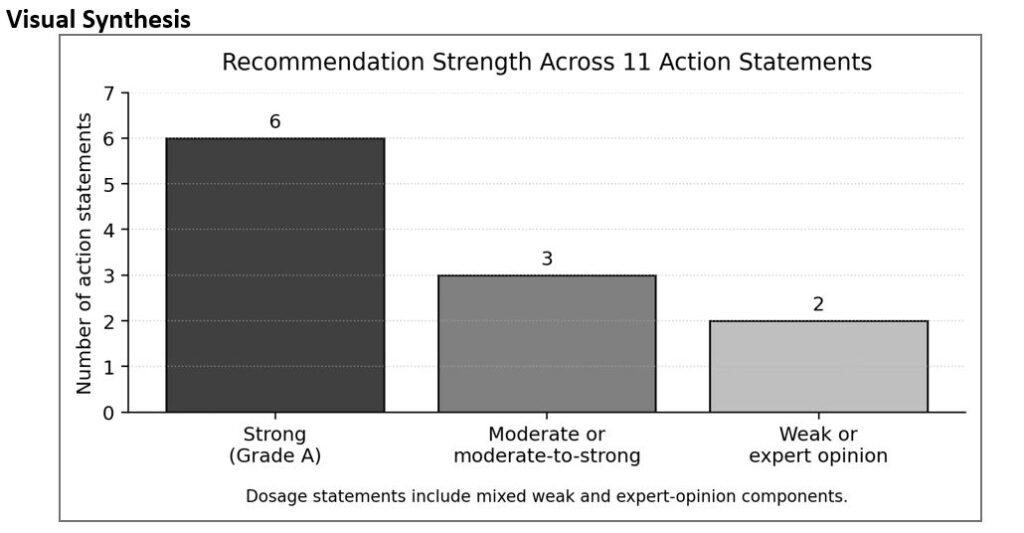
Figure 1. Distribution of recommendation strength across the guideline action statements. The strongest evidence supports offering vestibular physical therapy, supervised care, avoidance of isolated saccadic/smooth-pursuit exercises for gaze stability, and quality-of-life benefits.
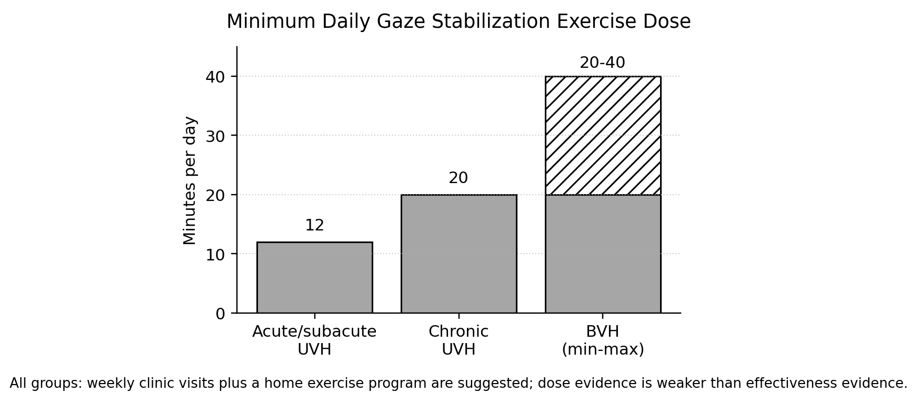
Figure 2. Minimum daily gaze stabilization exercise dosing summarized from the guideline. BVH recommendations include a range because bilateral loss often requires greater daily dosage and longer progression.
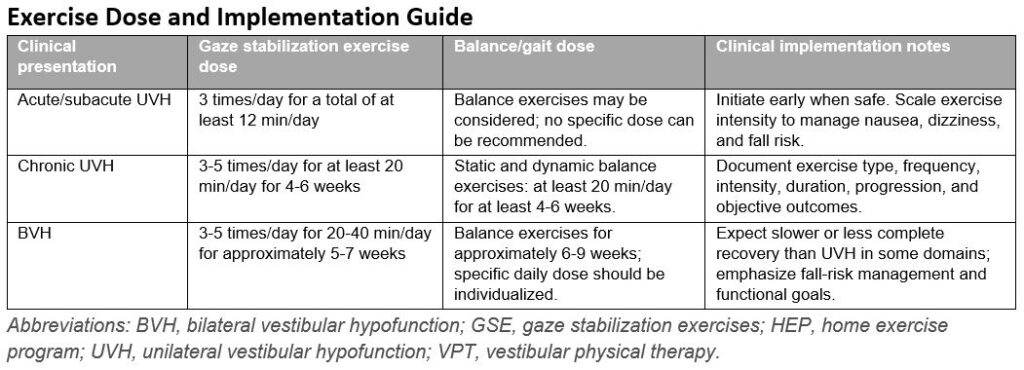
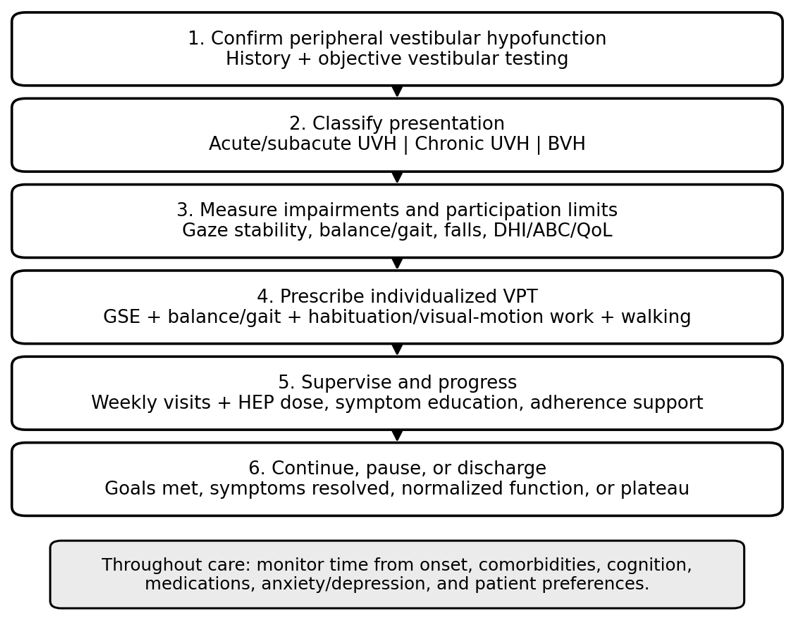
Figure 3. Practical VPT implementation pathway synthesized from the guideline action statements and implementation recommendations.
Reference
- Hall CD, Herdman SJ, Whitney SL, et al. Vestibular rehabilitation for peripheral vestibular hypofunction: an updated clinical practice guideline from the Academy of Neurologic Physical Therapy of the American Physical Therapy Association. J Neurol Phys Ther. 2022;46(2):118-177. doi:10.1097/NPT.0000000000000382