
Reviewed by Tyler Tice, PT, DPT, OCS, ATC
This double-blind randomized control trial aimed to assess the clinical effects of Kinesiotape (KT) regarding short term use on rotator cuff tendinopathy (RCT). KT is a conservative treatment for rotator cuff pathologies, inspired by traditional Japanese medicine. The tape is made with impermeable and non-degradable in water materials and is without ant added chemicals. KT provides traction to the skin, which may result in reduction of pressure on mechanoreceptors, providing relief to affected muscle and joint systems. Additionally, it is thought that KT improves blood and lymphatic circulation, however the pathophysiological mechanism is not fully understood.
Inclusion criteria for this study were: age between 20 and 60 years, shoulder pain before 150° of active elevation in any plane, pain during resisted external rotation, abduction or empty can test, and positive signs of conflict (Neer’s or Hawkins sign) on clinical examination. Patients were excluded if they had: progressive dermatological pathology, history of surgery, fracture or dislocation of shoulder, local corticosteroid infiltration in the previous 6 months, reproduction of symptoms during the cervical screening examination, cervical radiculopathy, or hyperpilosis that may impede the application of KT. Examination via Ultrasound was conducted to identify potential anatomical lesions (simple tendonitis, bursitis, calcification, or partial tear). Patients that unknowingly had a tear on the affected side were excluded.
Subjects were randomized into two groups. Standardized KT for shoulder pain (n=25) and sham KT application (n=25). Patients were instructed to maintain ADLs, but to avoid adding any new physical activity into their daily routine and to avoid analgesic therapy as much as possible. Both groups received 3 KT applications that were 4 days apart. The subjects were informed that two different techniques were used, but other details were withheld. For the KT group: a “Y”shaped strip was placed at the deltoid, from its insertion to its origin. The first tail of the band was applied to the anterior deltoid, with the patient’s arm in 60–80° horizontal abduction and complete external rotation, while the second tail was applied to the posterior deltoid, with the arm in 20–30° horizontal adduction and complete internal rotation. Additionally, an “I” strip was placed at supraspinatus muscle, applied from its insertion to its origin, with lateral cervical flexion to the opposite side and with the arm held behind the back. See below for the sham application.
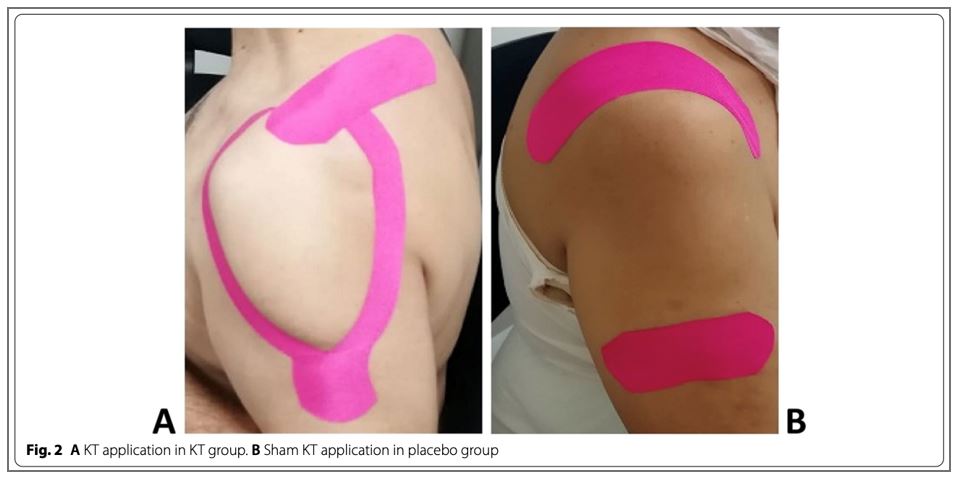
The DASH was used to determine outcomes. Repeat-measures ANOVA were used to analyze the data. both groups demonstrated significant DASH score improvements and VAS reports.
Limitations of this study include: shoulder ROM was not assessed, absence of a no-tape control group, various pathologies amongst the sample, and many patients reduced activity levels despite instructions.
As physical therapists, it is important that we do our best to strive for positive patient outcomes while promoting patient independence and ownership of their condition. KT is a potential short term intervention that could be used as an adjunct treatment to facilitate decreased pain levels and in turn, more patient buy-in for physical therapy. However, the main treatment focus should consist of: progressive loading, therapeutic exercise, and patient education to promote long-term independence and functional recovery.
References:
Taik FZ, Karkouri S, Tahiri L, et al. Effects of kinesiotaping on disability and pain in patients with rotator cuff tendinopathy: double-blind randomized clinical trial. BMC Musculoskelet Disord. 2022;23(1):90. Published 2022 Jan 26. doi:10.1186/s12891-022-05046-w